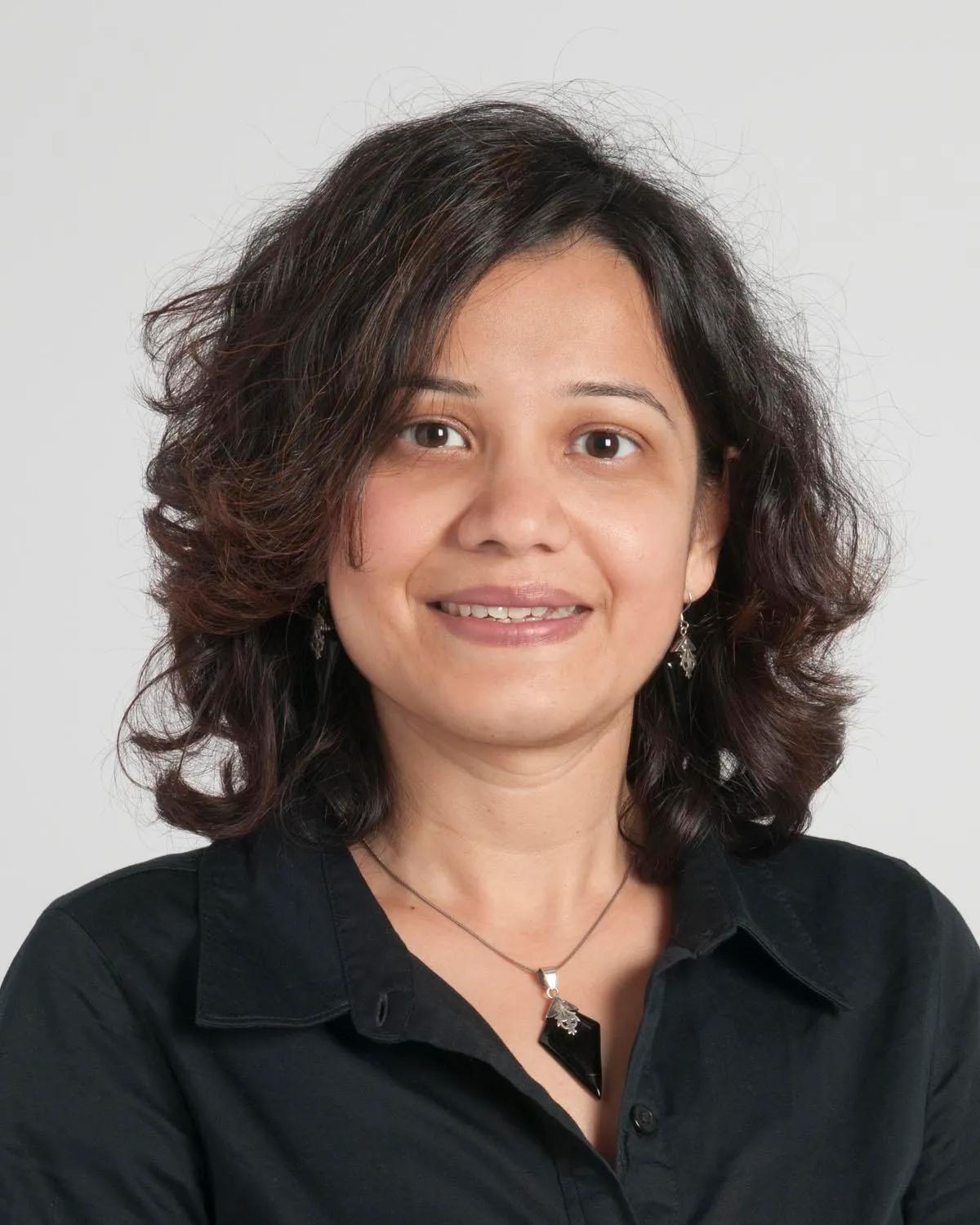
Fatema Ghasia, MD
StrabismusPediatric Ophthalmology
Highlights
Age Groups Seen
- Child
- Adolescent
- Adult
Languages
- English
Gender
FemaleAbout
Biography
Fatema Ghasia, MD, is a Professor of Ophthalmology at the Cleveland Clinic Cole Eye Institute and holds a faculty appointment at the Cleveland Clinic Lerner College of Medicine of Case Western Reserve University. She is a clinician-scientist specializing in pediatric ophthalmology, strabismus, and ocular motor disorders, and directs the Vision Neurosciences and Ocular Motility Laboratory at Cleveland Clinic. Her work integrates systems neuroscience, clinical ophthalmology, and advanced quantitative eye-tracking approaches to improve the diagnosis and management of binocular vision disorders.
Dr. Ghasia received her medical degree with distinction from the Medical College at the Maharaja Sayajirao University of Baroda, India. She completed extensive postdoctoral research training at Washington University in St. Louis, where her work focused on pediatric ophthalmology and binocular vision disorders, including children with cortical visual impairment, cerebral palsy, and other special needs. During this time, she developed expertise in electrophysiology and advanced eye movement analysis, with an emphasis on ocular motor control and its role in visual dysfunction. She subsequently completed her ophthalmology residency at Washington University and fellowship training in pediatric ophthalmology at Duke University.
Since joining Cleveland Clinic in 2012, Dr. Ghasia has maintained an active, high-volume clinical practice focused on pediatric ophthalmology, pediatric neuro-ophthalmology, adult strabismus, and amblyopia. Her clinical expertise spans the full age spectrum.
In pediatric patients, she specializes in the evaluation and management of a broad range of childhood eye diseases, including nasolacrimal duct disorders, amblyopia, strabismus, nystagmus, pediatric cataracts, and glaucoma. She has particular expertise in caring for children with complex visual and ocular motility abnormalities, including those with underlying neurological, developmental, and special needs conditions.
In adult patients, Dr. Ghasia is an experienced strabismus surgeon who manages complex ocular misalignment and binocular vision disorders, including cases related to neurological and orbital disease. Her approach emphasizes restoration of ocular alignment and functional binocular vision, with a focus on improving both visual performance and overall quality of life. Her extensive clinical experience provides a strong foundation for her translational research program, enabling rigorous patient phenotyping, longitudinal assessment, and the direct application of research findings to improve visual outcomes.
Dr. Ghasia has established a highly productive translational research program focused on the neural and behavioral mechanisms underlying amblyopia, strabismus, and related ocular motor disorders. Her laboratory is among a limited number nationally equipped for high-precision, pediatric-friendly measurement of eye and head movements and binocular function, including advanced video-oculography and integrated psychophysical testing platforms. She has developed innovative experimental paradigms and AI-enabled analytic pipelines to quantify visual sensory and visuomotor function in young children.
A central focus of Dr. Ghasia’s research is the development of objective biomarkers of visual function. Her work has demonstrated that eye movement abnormalities provide sensitive, quantifiable indicators of disease presence, severity, and treatment response in amblyopia and strabismus. She has further advanced this work through the integration of artificial intelligence–based methods to enable scalable, objective detection of childhood visual disorders. Her research also extends to neuro-ophthalmic applications, including studies of ocular motor dysfunction and the effects of deep brain stimulation in neurodegenerative diseases such as Parkinson’s disease, further broadening the translational impact of her program.
Dr. Ghasia has established a strong record of scholarly productivity and extramural funding, with support from Research to Prevent Blindness, the Knights Templar Eye Foundation, Fight for Sight, the Veterans Administration, the Blind Children’s Center, and institutional funding programs. Her work is highly collaborative, bridging ophthalmology, neuroscience, biomedical engineering, and neurology, and leveraging partnerships across Cleveland Clinic, the Cleveland VA Medical Center, and national multicenter research networks, including the Pediatric Eye Disease Investigator Group (PEDIG).
Dr. Ghasia is a dedicated educator and mentor who has trained numerous fellows, residents, postdoctoral researchers, and students in both clinical and research settings. Her mentorship has led to trainee-driven publications, national presentations, and competitive research awards, with many mentees advancing to successful careers in ophthalmology, neurology, and vision science. She contributes extensively to formal teaching through lectures, clinical instruction, and interdisciplinary training and is widely recognized for excellence in mentorship. She is also an invited lecturer nationally and internationally in the areas of visual neuroscience, pediatric ophthalmology, and eye movement disorders.
At the national level, Dr. Ghasia has demonstrated leadership through service on committees within the American Association for Pediatric Ophthalmology and Strabismus (AAPOS) and contributions to the Association for Research in Vision and Ophthalmology. She serves as a reviewer for the National Institutes of Health and other international funding agencies and holds editorial roles with multiple peer-reviewed journals. She is a member of the American Ophthalmological Society and has been recognized with several honors, including the AAPOS Young Investigator Award, the AAPOS Honors Award, and the Tracy Hull Award.
Dr. Ghasia’s work is distinguished by its strong mechanistic foundation, translational impact, and commitment to improving clinical care through objective, quantitative approaches. Her program continues to advance the understanding of binocular vision disorders and to develop scalable tools for early detection, monitoring, and treatment optimization in both pediatric and adult populations.
Education & Board Certifications
Education
- Fellowship: Duke University Medical Center , 2012
- Residency: Barnes-Jewish Hospital/Washington University School of Medicine, 2011
- Internship: St. Mary's Health Center, 2008
- Medical Education: Washington University School of Medicine, 2007
- Medical Education: Washington University School of Medicine, 2005
- Medical Education: Maharaja Sayajirao University of Baroda Faculty of Medicine, 2002
Board Certifications
- Ophthalmology: American Board of Ophthalmology, 2013
Awards
Association of University Professors of Ophthalmology travel award
The Association for Research in Vision and Ophthalmology travel grant
American Academy of Pediatric Ophthalmology and Strabismus Advocacy
Rosenbaum Resident research award
Pediatric Cataract and Glaucoma Foundation Award
American Academy of Pediatric Ophthalmology and Strabismus Young Investigator Award
Best Doctor’s Award (2022, 2023, 2024)
Top Research Mentor in Ophthalmology
Induction in American Ophthalmology Society
Professional Memberships
American Association of Pediatric Ophthalmology and Strabismus
The Association for Research in Vision and Ophthalmology
American Academy of Ophthalmology
Society For Neuroscience
Research & Publications
See publications for this provider. (Disclaimer: This search is powered by PubMed, a service of the U.S. National Library of Medicine. PubMed is a third-party website with no affiliation with Cleveland Clinic.)
Industry Relationships
Cleveland Clinic physicians and scientists collaborate with industry to advance medical breakthroughs. These partnerships help commercialize discoveries for public benefit while maintaining scientific integrity. To ensure transparency and minimize potential bias, Cleveland Clinic reviews these relationships and publicly discloses when physicians/scientists receive significant compensation for consulting, serve in fiduciary roles, receive royalties, or hold equity interests related to their work. We manage potential conflicts through approval processes, annual reporting, and targeted management plans.
As of 2026-03-30, Dr. Ghasia has reported no financial relationship with industry that is applicable to this listing.
In general, patients should feel free to contact their doctor about any of the relationships and how the relationships are overseen by Cleveland Clinic. To learn more about Cleveland Clinic's policies on collaborations with industry and innovation management, go to our Integrity in Innovation page.
Public Health Service-Reportable Financial Conflicts of Interest. Cleveland Clinic scientists and physicians engage in basic, translational and clinical research activities, working to solve health problems, enhance patient care and improve quality of life for patients. Interactions with industry are essential to bringing the researchers' discoveries to the public, but can present the potential for conflicts of interest related to their research activities. Click here to view a listing of instances where Cleveland Clinic has identified a Public Health Service (PHS)-Reportable Financial Conflict of Interest and has put measures in place to ensure that, to the extent possible, the design, conduct and reporting of the research is free from bias.
* Cleveland Clinic physicians and scientists subscribe to the guidance presented in the PhRMA Code on Interactions with Healthcare Professionals and the AdvaMed Code of Ethics on Interactions with Health Care Professionals. As such, gifts of substantial value are generally prohibited.
Insurances Accepted
Video
Reviews
4.4 of 5 stars
58 Ratings, 5 ReviewsThe Patient Satisfaction Rating is an average of all responses to the care provider related questions shown below from our survey. Patients that are treated in outpatient or hospital environments may receive different surveys, and the volume of responses will vary by question.
- 5 out of 5 starsReviewed on 9/14/2026
We are always treated with kindness amd listening ears. Gabriel loves the team.
- 2 out of 5 starsReviewed on 6/2/2026
There was never an apology for us waiting over 2 hours past our appointment time to be seen by the physician. She was only in the room for 2 minutes. She did not even examine my daughter''s eyes. I work for Cleveland clinic as a registered nurse and could not believe the lack of bedside manner.
- 5 out of 5 starsReviewed on 1/14/2026
I love his eye doctor
- 5 out of 5 starsReviewed on 11/4/2025
You could tell she was rushed but she was nice to us
- 5 out of 5 starsReviewed on 9/19/2025
Dr Ghasia was very good,